
In the ever-evolving landscape of education, technology has become a powerful ally in making learning more engaging and effective. One platform that stands at the forefront of this educational revolution is PhET Interactive Simulations, a project from the University of Colorado Boulder. Founded in 2002 by Nobel Laureate Carl Wieman, PhET provides a suite of free, research-based, and interactive simulations for science and mathematics. These aren’t just animations; they are dynamic and game-like environments where students from elementary school to university can learn through exploration and discovery.
The initial vision for PhET—which originally stood for Physics Education Technology—was to improve how science is taught and learned. That vision has since expanded to encompass a wide range of STEM fields, with a steadfast mission: to advance science and math literacy worldwide.
Why It’s Effective: A Multifaceted Approach
The success of PhET simulations in transforming classrooms globally can be attributed to several key factors that work in concert to create a rich and accessible learning experience.
Accessibility & Reach: Breaking Down Barriers
A core tenet of the PhET project is to make science and math education accessible to everyone. The simulations are free to use for all students and educators. Recognizing the global nature of learning, the PhET team and a dedicated community of translators have made these resources available in over 121 languages, breaking down linguistic barriers and fostering a worldwide community of learners.
Beyond language, PhET is committed to making its simulations accessible to students with disabilities. In 2014, the project launched an initiative to enhance the accessibility of its HTML5 simulations. This has led to the development of features such as
- Keyboard Navigation: Allowing users to interact with simulations without a mouse, which also benefits those using assistive devices.
- Auditory Descriptions and Sonification: Providing non-visual ways to experience the simulations through screen readers and sound-based representations of data.
- Alternative Input Methods: Supporting various assistive technologies to ensure all students can participate.
These inclusive design principles ensure that a wider range of learners can engage with and benefit from these powerful educational tools.
Subjects Covered: A Universe of Exploration
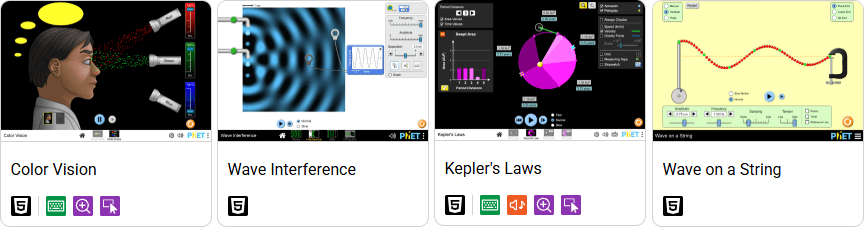
What began with a focus on physics has blossomed into a comprehensive collection of over 160 simulations across a multitude of subjects. This allows educators to identify relevant, interactive content for a wide array of curriculum needs.
- Physics: Students can learn more about the fundamental principles of the universe with simulations like “Forces and Motion,” where they can explore the relationship between force, mass, and acceleration, or “Circuit Construction Kit,” which allows them to build and analyze virtual circuits. Other simulations explore concepts like gravity, energy, and waves.
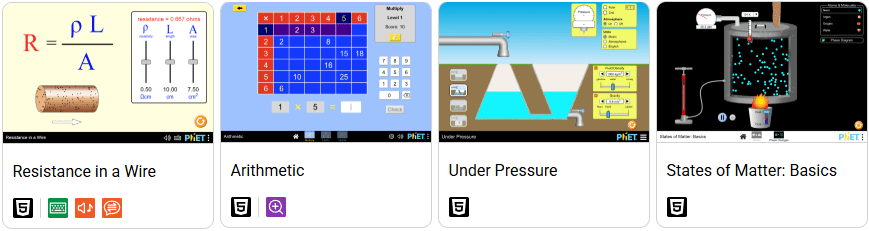
- Chemistry: Abstract chemical concepts come to life with simulations such as “Build an Atom,” where students can construct atoms and explore isotopes, and “Balancing Chemical Equations,” which provides a visual and interactive way to understand stoichiometry. Students can also investigate pH, states of matter, and gas properties.
- Mathematics: Math becomes more intuitive and less abstract with simulations like “Function Builder” and “Area Model Algebra,” which help students visualize and understand key mathematical relationships. Other simulations tackle topics such as trigonometry, fractions, and statistics.
- Biology: From the microscopic to the macroscopic, PhET’s biology simulations cover a wide range. “Natural Selection” allows students to run their own evolutionary experiments, while “Gene Expression Essentials” provides a window into the fundamental processes of life. Other simulations explore neurons, membrane channels, and ecosystems.
- Earth Science: Students can investigate our planet and its systems through simulations like “The Greenhouse Effect,” which visualizes the impact of greenhouse gases, and “Plate Tectonics,” which allows for the exploration of geological processes.
Teacher-Friendly Features: Empowering Educators
PhET understands that a great tool is only as effective as the way it’s used. That’s why they provide a wealth of resources to support educators in integrating these simulations into their teaching.
A cornerstone of this support is the PhET Activities Database, a vast and growing collection of lesson plans, homework assignments, lab activities, and more, created by both the PhET team and a global community of teachers. This database allows educators to find and adapt resources that are aligned with their specific teaching goals and standards. Many activities are designed to foster “guided inquiry,” a research-backed approach that encourages students to construct their own understanding through exploration.
For each simulation, educators can also find “Tips for Using PhET,” which offer guidance on how to effectively facilitate learning, and video primers that provide a quick overview of the simulation’s features and learning goals. Teachers can even register for a free account to access additional resources and contribute their materials to the community.
Impact & Evidence: A Research-Driven Approach
PhET is not just about creating cool tools; it’s about creating effective ones. The design of every simulation is grounded in educational research on how students learn best. This commitment to a research-based approach has led to a significant body of evidence demonstrating the positive impact of PhET simulations on student learning.
Numerous studies have shown that using PhET simulations can lead to:
- Improved Conceptual Understanding: Research across various subjects and grade levels has consistently shown that students who use PhET simulations develop a deeper and more robust understanding of scientific concepts compared to traditional teaching methods alone.
- Enhanced Engagement and Motivation: The interactive and game-like nature of the simulations makes learning more enjoyable and engaging for students, which can lead to increased motivation and interest in STEM subjects.
- Development of Critical Thinking and Scientific Skills: PhET simulations encourage students to ask questions, design experiments, and analyze data, thereby fostering critical thinking and scientific inquiry skills.
One study on elementary school students found that those who used a PhET simulation to learn about solubility not only achieved significantly higher scores but were also better able to explain their reasoning. Another study focusing on general chemistry students revealed that PhET simulations helped them grasp abstract concepts and provided learning opportunities not available in traditional lab settings.
Conclusion: A Gateway to Deeper Understanding
PhET Interactive Simulations offer a powerful and versatile tool for educators looking to bring science and math to life in their classrooms. By combining a commitment to accessibility, a broad range of subjects, robust teacher support, and a foundation in educational research, PhET provides an unparalleled resource for fostering a love of learning and a deeper understanding of the world around us. In an age where digital literacy and STEM skills are more important than ever, PhET is paving the way for a more engaging, equitable, and effective educational future.


 Start Your Online Jobs
Leave a comment