In 2026, the digital marketing landscape has undergone a seismic shift. The traditional “social media” model—where users followed friends and family—has almost entirely given way to the “content discovery” model. At the forefront of this revolution is TikTok.
For businesses, TikTok is no longer an optional “experimental” channel; it is the primary engine for product discovery, brand building, and direct commerce. With billions of users spending an average of over 90 minutes a day on the platform, the opportunity to scale is unprecedented. However, the landscape has shifted. This comprehensive guide will walk you through everything from your first campaign to advanced AI-driven performance strategies, ensuring your business doesn’t just survive on TikTok but dominates.
Part 1: The Beginner’s Blueprint—Setting the Foundation
1. TikTok Ads: Everything New Advertisers Need to Know
The first thing a new advertiser must understand is that TikTok is a sound-on, full-screen, vertical video environment. Unlike other platforms where users might scroll with the sound off, TikTok is immersive.
The TikTok Ads Manager is the command center where you will build, launch, and track your ads. It is structured into three layers:
- Campaigns: Where you set your objective (e.g., sales, traffic, app installs).
- Ad Groups: Where you define your audience, budget, and placement.
- Ads: The creative videos that users actually see.
2. Getting Started With TikTok for Business in 2026
To begin, you need a TikTok Business Center account. In 2026, the integration between organic presence and paid advertising is seamless. You should link your official brand account to your Business Center to utilize Spark Ads—a format that allows you to boost organic videos while maintaining all the social engagement (likes, comments, and shares) they’ve already earned.
Key setup requirements include the following:
- The TikTok Pixel & Events API: This is non-negotiable. It tracks what users do on your website after seeing your ad.
- Two-Factor Authentication: Essential for protecting your ad spend.
- Payment Setup: TikTok offers both manual and automatic payment options.
3. Your First TikTok Ad Campaign: A Step-by-Step Guide
- Select Your Objective: For most businesses, the primary goal will be product sales (if you have an online store) or lead generation.
- Define Your Audience: You can target by interests or behaviors (e.g., “watched DIY videos to the end”) or use Smart+ Targeting, which allows TikTok’s AI to find the best audience for you.
- Set Your Budget: Start with a daily budget you are comfortable with, but ensure it is high enough for the algorithm to “learn” (usually at least 20x your target cost per action).
- Upload Creative: Use the TikTok Video Editor within the dashboard to add music, text overlays, and stickers.
- Launch and Monitor: Avoid making changes for the first 48–72 hours while the algorithm optimizes.
4. Common TikTok Advertising Mistakes and How to Avoid Them
- Mistake: Over-Producing Content. If your ad looks like a $50,000 TV commercial, people will swipe past it. It feels like an interruption. The Fix: Film on a smartphone. Keep it raw and authentic.
- Mistake: Forgetting the CTA. Users need to be told what to do. The Fix: Use clear, verbal calls-to-action like “Click the link below” or “Shop the sale now.”
- Mistake: Ignoring the Safe Zone. TikTok has UI elements (like the “Like” button and caption) that cover the edges of the screen. The Fix: Keep all text and logos in the center of the frame.
5. How Small Businesses Can Win With TikTok Ads
Small businesses have a unique advantage: agility. You don’t need a massive agency.
- Hyper-Local Targeting: Use zip code or city-level targeting to reach your local community.
- Community Interaction: Reply to every comment on your ads. This boosts the video’s engagement score and builds trust.
- Leverage Trends: Use trending sounds (that you have commercial rights to) to make your brand feel current.
Part 2: eCommerce & Sales – Turning Discovery Into Dollars
1. How TikTok Turns Product Discovery Into Sales
On search engines, people look for what they know they want. On TikTok, people discover what they didn’t know they needed. This is the “Discovery Engine.” The algorithm analyzes user behavior to predict what products will resonate with them, effectively creating demand where none existed.
2. The TikTok Commerce Playbook for Online Stores
In 2026, the most successful brands use a TikTok Shop integration. This allows users to buy products directly within the app without ever leaving the video.
- The Playbook: Sync your product catalog, set up a “Shop” tab on your profile, and run Video Shopping Ads (VSA). VSAs are specialized ads that pull real-time pricing and inventory data from your shop.
3. Why Products Go Viral on TikTok and What Brands Can Learn
Virality isn’t luck; it’s a formula. Products go viral when they:
- Solve a Visual Problem (e.g., a cleaning product that removes a stain instantly).
- Have a “Wow” Factor: Something unexpected or aesthetically pleasing.
- Are Relatable: Content that makes a user say, “That’s so me.”
Brands should focus on the “user benefit” in the first 2 seconds to trigger the algorithm’s viral potential.
4. Using TikTok Shopping Ads to Boost Revenue
Shopping ads are the evolution of the dynamic product ad. They are optimized for “lower-funnel” actions.
- Retargeting: Show ads to people who added an item to their cart but didn’t buy.
- Live Shopping: Run ads that drive traffic to a livestream where you sell products in real time. This is currently the highest-converting format on the platform.
5. The Future of Social Commerce Starts on TikTok
They are moving toward a frictionless economy. In the future, every video will be “shoppable.” Whether it’s a creator’s review or a brand’s tutorial, the distance between “I want that” and “I bought that” is shrinking to a single click. TikTok is at the forefront of this trend by building its own logistics and fulfillment networks.
Part 3: Typical ad formats on TikTok
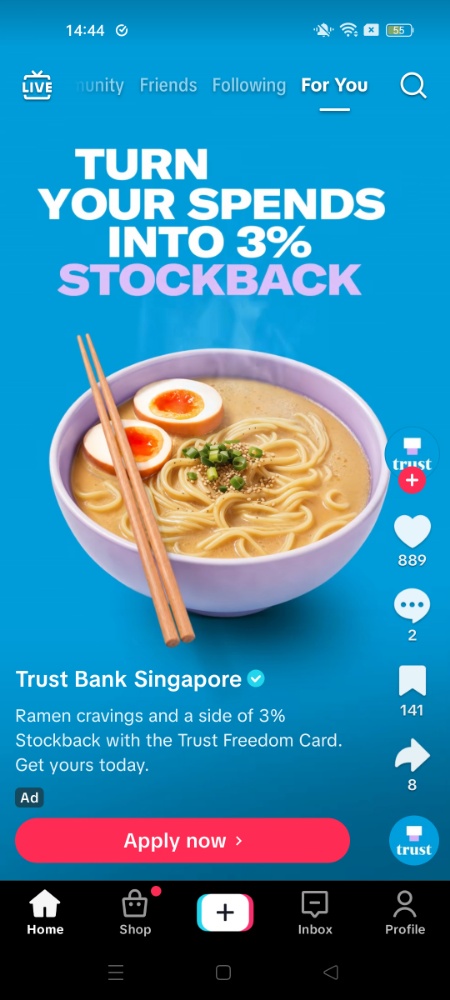
1. In-Feed Native Image/Video Ad
- Format Name: In-Feed Ad / Standard Brand Ad
- How it works: This format appears seamlessly in the user’s main “For You” feed as they scroll through videos. It includes standard engagement buttons (likes, comments, and shares) alongside a prominent call-to-action (CTA) button at the bottom (e.g., “Apply now”).
- Best used for: Driving external traffic to a website, app downloads, lead generation, or brand awareness.
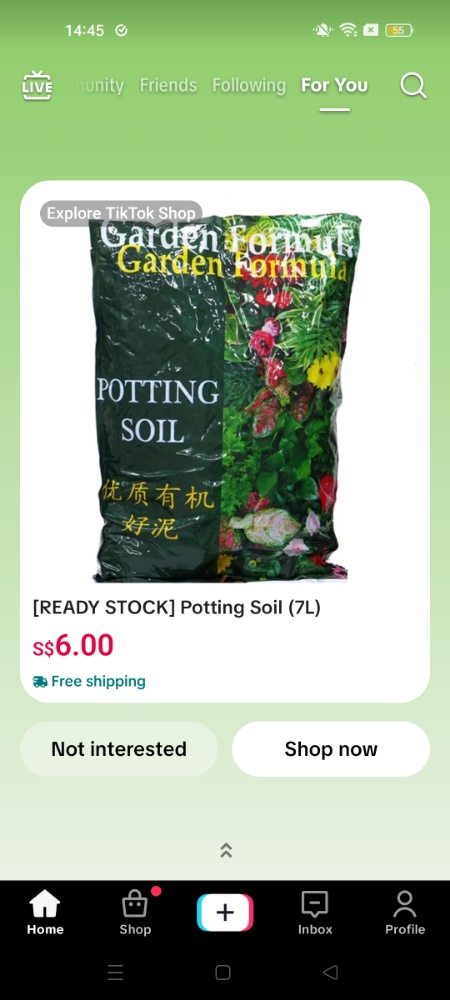
2. Shopping Showcase Card / Collection Ad
- Format Name: TikTok Shop Shopping Card / Product Display Ad
- How it works: Instead of a full video, the format presents a clean product card pop-up directly in the feed, highlighting key details such as the item title, price (
S$6.00), special offers (like free shipping), and an instant “Shop now” button. - Best used for: Direct e-commerce sales and impulse buys on TikTok Shop.
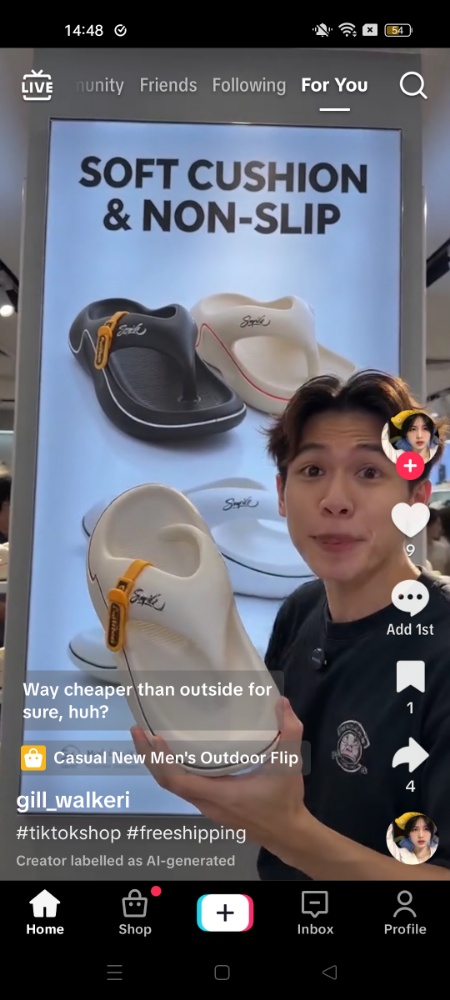
3. Shoppable Creator Video / TikTok Shop Video Ad
- Format Name: Shoppable Video Ad (Creator / Affiliate Promotion)
- How it works: A creator-led video demonstrates or reviews a product. It features an integrated clickable shopping tag (yellow shopping bag icon) directly over the video, allowing viewers to purchase the item without leaving the app.
- Best used for: Organic-style product demonstrations, influencer marketing, and leveraging social proof to drive sales that are directly trackable.
There are also several other ad formats to consider on TikTok outside of these three. Brands also use high-visibility and interactive formats depending on their goals:
1. TopView Ads
- What it is: The first ad a user sees immediately upon opening the TikTok app.
- Key Feature: It takes over the full screen with sound auto-on for up to 60 seconds, guaranteeing maximum visibility and high brand awareness.
2. Branded Hashtag Challenge
- What it is: A user-generated content (UGC) campaign where a brand invites users to create videos performing a specific action or dance using a custom hashtag.
- Key Feature: Appears on the Discover/Search page and drives massive engagement and viral organic reach.
3. Branded Effects / Filters
- What it is: Custom 2D, 3D, or AR filters, stickers, and special effects created by brands for users to incorporate into their videos.
- Key Feature: Highly interactive and often paired with branded hashtag challenges.
4. Spark Ads
- What it is: A native ad format that allows brands to boost existing organic videos—either from their account or from creators (with permission)—instead of creating standard ads.
- Key Feature: All views, likes, and shares accumulate on the original organic post.
5. LIVE Shopping Ads
- What it is: Real-time ads that direct users straight from their feed into an active TikTok Shop LIVE stream.
- Key Feature: Boosts real-time traffic and viewer count during live sales events.
Part 4: Creative & Content—The New Standard for Marketing
1. What Makes a High-Converting TikTok Ad?
A high-converting ad follows the hook-body-CTA structure:
- The Hook (0–3 seconds): A visual or auditory “stop” that prevents the swipe.
- The Body (3–12 seconds): The value proposition. Why does this matter?
- The CTA (12–15 seconds): A clear instruction.
2. TikTok-First Creative: The New Standard for Brand Marketing
“TikTok-First” means the content was designed specifically for the platform’s culture. This involves using native fonts, green-screen effects, and the fast-paced editing style typical of the “For You” feed. Brands that repurpose Instagram or YouTube ads usually see a 50% lower ROI.
3. How to Create TikTok Ads That Feel Native and Authentic
The best ads don’t feel like ads; they feel like TikToks.
- Use UGC (User-Generated Content): Partner with creators to film themselves using your product.
- Show the Founder: People connect with people. A founder talking about their mission feels more authentic than a voiceover artist.
4. The Psychology of Viral TikTok Marketing
TikTok taps into the brain’s reward system. The “variable reward” of the infinite scroll keeps users engaged. To go viral, your ad must provide an immediate hit of entertainment, education, or inspiration. This is why “Life Hacks” and “Storytimes” perform so well—they provide value before they ask for a sale.
5. Creative Best Practices for TikTok Advertising Success
- Resolution: Always 1080×1920 (9:16 vertical).
- Sound: Never run an ad without music or a voiceover.
- Captions: Use on-screen text to highlight key points, as many users may sound low (though usually on).
Iteration: Don’t just make one ad. Make five versions with different hooks to see which one sticks.
Part 5: Performance Marketing – Scaling and Optimization
1. Maximizing ROAS With TikTok Ads: Proven Strategies
To maximize Return on Ad Spend (ROAS), you must move beyond basic targeting.
- Value-Based Bidding: Tell TikTok to find users who are likely to spend the most money, not just those likely to click.
- Lookalike Audiences: Upload your customer list and ask TikTok to find 1–5% of the platform that shares their characteristics.
2. How Performance Marketers Scale on TikTok
Scaling on TikTok is different from Meta.
- Horizontal Scaling: Instead of just increasing the budget of one ad, create dozens of new creative variations to reach different sub-segments of your audience.
- Vertical Scaling: Increase the budget by 20% every 48 hours if the ROAS remains stable. Avoid “budget shocks” that can reset the learning phase.
3. TikTok Advertising Metrics That Actually Matter
Don’t get distracted by “vanity metrics” like likes. Focus on:
- Hook Rate: (3-second views / Impressions) If this number is low, your creativity is boring.
- Hold Rate: (Watch time / Video length). If the rate is low, your content isn’t engaging.
- Conversion Rate (CVR): The percentage of people who buy after clicking.
- ROAS: Your bottom-line profitability.
4. Data-Driven Growth With TikTok Ads
Use the TikTok Creative Center to analyze what is working in your industry. Data-driven growth involves constant A/B testing. Test your hook, your music, and your CTA separately to build a “champion” ad.
5. Optimizing TikTok Campaigns for Better Conversions
If your ads aren’t converting, look at your landing page. TikTok users expect a quick, mobile-optimized experience. If your website takes more than 3 seconds to load, you’ve lost the sale. Use Instant Pages within TikTok—lightweight, fast-loading landing pages that live inside the app—to bridge the gap.
Part 7: AI & Future Trends – The Next Frontier
1. How AI Is Changing TikTok Advertising
Artificial intelligence is now the backbone of TikTok. In 2026, AI doesn’t just decide who sees your ad; it helps make the ad. TikTok’s algorithm now uses “computer vision” to analyze the literal pixels of your video to understand the context, sentiment, and quality, ensuring it’s shown to the most relevant users.
2. The Future of Performance Marketing on TikTok
They are moving toward “Zero-Segment Marketing.” Soon, marketers won’t choose interests at all. You will simply provide the product and the creative, and the AI will take care of the rest. The focus of the performance marketer is shifting from “media buying” to “creative direction.”
3. TikTok Advertising Trends Every Marketer Should Watch
- Search Ads: Users are using TikTok like Google. “How to…” and “Best [Product] for…” searches are skyrocketing. Bidding on these keywords is a massive opportunity.
- AR (Augmented Reality) Ads: “Try-on” filters for makeup, glasses, and furniture are becoming standard.
- Virtual Influencers: AI-generated creators that work 24/7 for your brand.
4. Smarter Campaigns: Using Automation to Improve TikTok Results
Symphony Creative Studio is TikTok’s AI suite that can automatically generate video variations, translate your ads into different languages while keeping your voice, and even suggest which trends your brand should join. Leveraging these automated tools is essential for staying competitive.
5. What’s Next for Brands on TikTok?
The line between entertainment and commerce will continue to blur. We expect to see more interactive ads, gamified shopping experiences, and a deeper integration into the physical world (O2O—Online to Offline). Brands that treat TikTok as a two-way conversation rather than a megaphone will be the ones that own the market in the years to come.
Part 6: TikTok algorithm in 2026
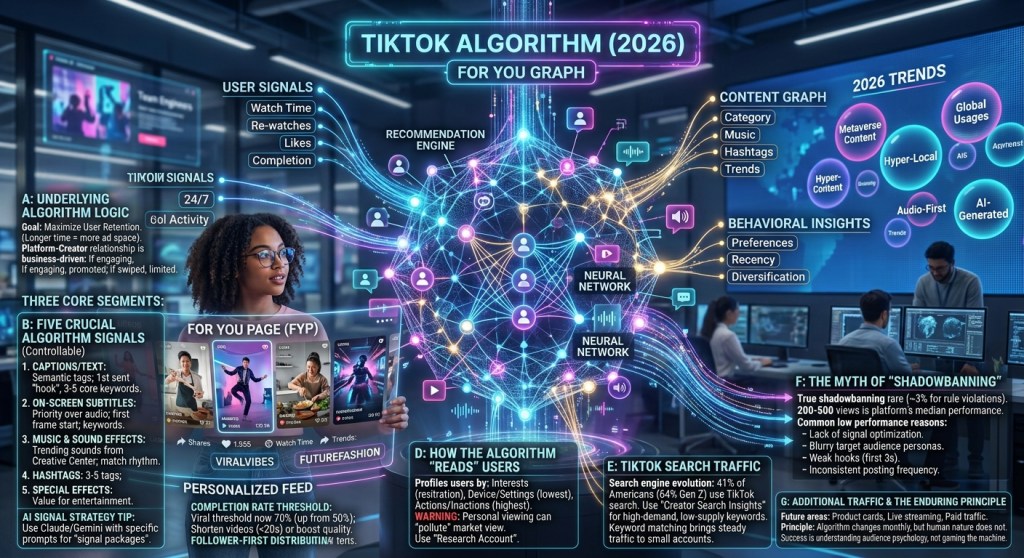
The structure of TikTok’s algorithm in 2026 consists of three core segments:
- Five essential algorithm signals for video posting.
- Four major changes in the 2026 algorithm.
- The reality of “shadowbanning” is that it affects 99% of creators who believe they are limited.
A: Underlying Algorithm Logic
TikTok’s primary goal is to maximize user retention—the longer you stay on the app, the more ad space they can sell. The relationship between the platform and the creator is purely business-driven: if your content keeps users engaged, TikTok will promote it; if viewers swipe away quickly, it won’t.
B: Five Crucial Algorithm Signals
While TikTok officially considers seven dimensions, two (existing views and location) are beyond immediate control. Matthew focuses on the five controllable signals:
- Captions/Text: These are semantic tags for the algorithm. The first sentence should be a “hook,” and the subsequent text should naturally include 3-5 core keywords.
- On-screen Subtitles: The algorithm prioritizes reading on-screen text over audio recognition. Subtitles should appear from the first frame and include keywords.
- Music and Sound Effects: Videos with background music average 98% more views. Creators should use “trending sounds” from the TikTok Creative Center that match their content’s rhythm.
- Hashtags: Use 3-5 tags, mixing broad, high-traffic ones with niche, precise ones.
- Special Effects: These add value primarily to entertainment content.
Strategy Tip: Use AI tools like Claude or Gemini with specific prompts to generate optimized “signal packages” for your videos.
C: Four Major Algorithm Changes in 2026
- Completion Rate Threshold: The “viral” threshold for completion rates has jumped from 50% to 70%. Creators must either shorten videos (under 20 seconds) or significantly increase quality to maintain viewer interest.
- Follower-First Distribution: Unlike previous years, TikTok now tests videos with your current followers first. If they don’t engage, the video won’t be pushed to non-followers. This makes follower quality more important than quantity.
- Share Weight Increase: Sharing and saving now carry more weight than likes or comments. Content must provide practical or social value to encourage sharing.
- First-Hour Interaction: The first hour after posting determines 80% of a video’s potential. Creators should post during peak audience hours and actively reply to comments in the first 30 minutes to boost engagement signals.
D: How the Algorithm “Reads” Users
The algorithm profiles users based on:
- Interests selected during registration.
- Device/account settings (language, location—lowest weight).
- Actions/Inactions (completion, likes, shares, accounts followed—highest weight).
Matthew warns creators that their personal viewing habits can “pollute” their understanding of the market. He recommends a dedicated “research account” with a clean profile to see what the target audience actually sees.
E: TikTok Search Traffic
TikTok is evolving into a search engine. 41% of Americans (and 64% of Gen Z) use TikTok for searches. The new “Creator Search Insights” tool helps creators find high-demand, low-supply keywords. High keyword matching can bring steady traffic even to small accounts with low follower counts.
F: The Myth of “Shadowbanning”
The true shadowbanning is rare (affecting ~3% of accounts who violate community rules). Most “low views” (200-500) are actually the platform’s median performance. Common reasons for poor performance include:
- Lack of signal optimization.
- Blurry target audience personas.
- Weak hooks (first 3 seconds).
- Inconsistent posting frequency.
G: Additional Traffic
There are three other traffic types for TikTok Shop: Product cards, Live streaming, and Paid traffic, promising future videos on these. The algorithm changes every few months, but human nature does not. Success comes from understanding the audience’s psychology rather than just trying to “game” the machine.
Conclusion: The Path Forward
Driving growth with TikTok in 2026 requires a blend of creative bravery and technical precision. For the new advertiser, the journey begins with a single, authentic video. For the established brand, it requires an aggressive embrace of TikTok Shop and AI-driven optimization.
The TikTok for Business platform provides the tools, but your brand provides the soul. Remember:
- Be Native: Content first, ads second.
- Be Data-Driven: Test, measure, and iterate.
- Be Frictionless: Use TikTok Shop to make buying effortless.
The future of commerce is here. It’s vertical, it’s loud, and it’s waiting for your brand to join the conversation. Start your first campaign today.



Leave a Reply